
Case Studies
From Fragmented Enterprise Data to Connected Business Decisions
A Cross-Industry Investigation of Profitability Drivers Across Commercial, Finance, Manufacturing, Procurement and Leadership Intelligence
Published
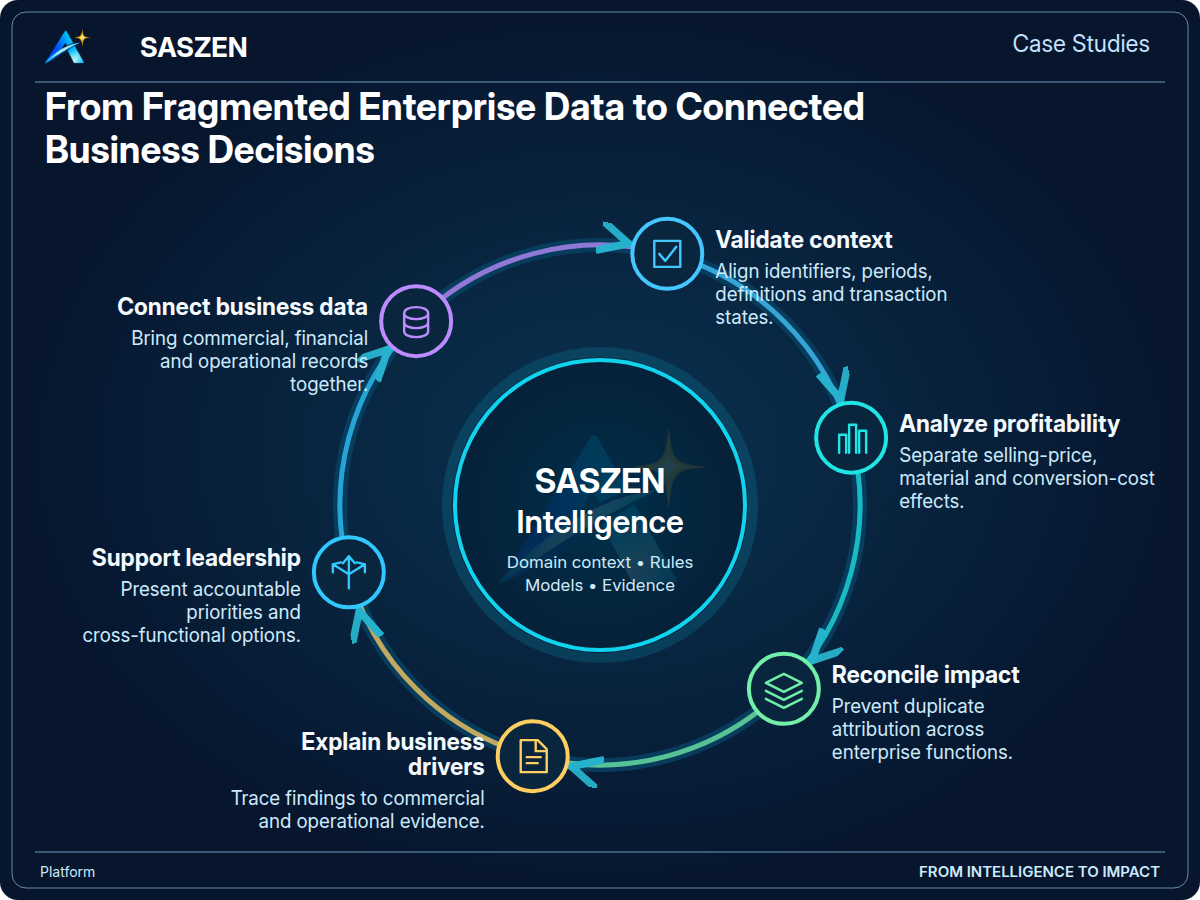
Read the article-specific process stages
- Connect business dataBring commercial, financial and operational records together.
- Validate contextAlign identifiers, periods, definitions and transaction states.
- Analyze profitabilitySeparate selling-price, material and conversion-cost effects.
- Reconcile impactPrevent duplicate attribution across enterprise functions.
- Explain business driversTrace findings to commercial and operational evidence.
- Support leadershipPresent accountable priorities and cross-functional options.
Your prepared LinkedIn post
Paste your prepared post into LinkedIn, review, and click Post.
A Cross-Industry Investigation of Profitability Drivers Across Commercial, Finance, Manufacturing, Procurement and Leadership Intelligence
Executive Summary
Enterprise organizations generate enormous volumes of business information through financial applications, procurement systems, manufacturing platforms, customer management solutions and enterprise resource planning systems.
Yet critical business decisions often require more than the information available within any single application.
A change in profitability, for example, may be associated with customer pricing, supplier costs, manufacturing performance, inventory movements, contractual conditions and financial adjustments. These relationships frequently cross organizational and system boundaries.
SASZEN’s internal research examined how these business dimensions interact and how an enterprise intelligence approach can connect the information required for more effective investigation and decision-making.
The analysis focused on five enterprise intelligence domains:
- Commercial Intelligence: Customer pricing, agreements, revenue performance and commercial exceptions.
- Finance Intelligence: Profitability, financial variances, reconciliation and exposure.
- Manufacturing Intelligence: Production performance, yield, quality and operational costs.
- Procurement Intelligence: Supplier pricing, purchasing conditions and sourcing performance.
- Leadership Intelligence: Cross-functional priorities, financial implications and coordinated decisions.
The central research conclusion is that enterprise profitability cannot always be adequately explained through isolated departmental analysis. A more complete explanation requires consistent business identifiers, aligned time periods, governed calculations, transaction history and traceable evidence across functions.
This case study presents SASZEN’s analytical approach, supporting financial relationships, decision framework and cross-industry applicability.
Enterprise Intelligence, Connected. From Intelligence to Impact.
1. Research Objective
The primary objective was to examine how business information from multiple enterprise functions can be connected to improve the explanation of financial and operational performance.
The analysis was organized around five research questions:
- How do commercial pricing, procurement costs and manufacturing performance jointly influence profitability?
- What information is required to distinguish financial symptoms from underlying business drivers?
- How can enterprise information be normalized without losing the context of source transactions?
- How should financial exposure and operational variances be reconciled to avoid duplicate or misleading conclusions?
- How can analytical findings support accountable decisions across enterprise functions?
The research also examined how a common intelligence foundation could be adapted to different industries without requiring every organization to adopt an identical business process.
2. Research Scope and Methodology
SASZEN’s internal research materials cover enterprise processes, analytical rules, evidence requirements, specialized Analyst concepts and governance principles.
The study organizes those materials into a cross-functional analytical methodology.
2.1 Business Dimensions Examined
| Dimension | Representative Information | Analytical Purpose |
|---|---|---|
| Commercial | Sales, customers, agreements, pricing conditions, discounts | Explain realized revenue and commercial exposure |
| Procurement | Purchase orders, supplier prices, material costs, contract conditions | Identify purchasing cost changes and supplier-related variances |
| Manufacturing | Production orders, consumption, yield, scrap, quality and conversion costs | Explain manufacturing performance and unit-cost changes |
| Finance | Revenue, cost, accruals, adjustments and profitability | Reconcile operational findings with financial results |
| Leadership | KPIs, risks, priorities, ownership and decisions | Coordinate responses across business functions |
2.2 Analytical Method
The methodology follows six stages:
Ingest → Validate → Detect → Explain → Review → Track
This process connects approved source information, validates business context, identifies findings, develops evidence-supported explanations, enables human review and tracks outcomes.
The research emphasizes that source systems remain authoritative for their transactions. The intelligence layer supports analysis and decisions rather than replacing ERP, finance, procurement or manufacturing systems.
2.3 Analytical Boundaries
The research combines enterprise business-domain analysis, analytical frameworks and controlled financial reference calculations.
The numerical examples explain financial relationships and reconciliation methods. They are not presented as measured customer savings, validated production results or independently audited financial findings.
The study also distinguishes SASZEN’s enterprise platform vision from the current availability of individual specialized Analysts.
3. The Enterprise Challenge: Different Functions, Different Explanations
An enterprise may experience declining product profitability while reporting relatively stable sales volumes.
Commercial teams may identify changes in realized selling prices. Procurement teams may identify higher material acquisition costs. Manufacturing teams may report unfavorable yield or efficiency variances.
Finance may observe declining margins without immediately knowing which operational factors explain the movement. Leadership must determine which issues are material, which explanations are supported by evidence and which decisions should receive priority.
The challenge is not simply to collect more reports.
It is to establish a consistent relationship among:
- Business transactions and master-data identifiers.
- Contractual and operational conditions.
- Effective dates and accounting periods.
- Financial calculations and cost classifications.
- Historical changes, corrections and adjustments.
- Business ownership and decision authority.
Without this consistency, the same event can be interpreted differently across departments or counted more than once.
The enterprise challenge is not a lack of information. It is the difficulty of connecting information to a consistent business explanation.
4. Financial Analysis: Understanding Profitability Drivers
To explain cross-functional financial relationships, SASZEN’s methodology uses a contribution-margin bridge.
4.1 Financial Analysis Basis
SASZEN’s internal research examines the relationships among commercial pricing, procurement costs, manufacturing performance and financial outcomes.
The following financial model provides a controlled numerical reference for demonstrating these relationships. Its purpose is to show how cross-functional variances can be calculated, reconciled and interpreted using consistent business definitions.
The calculations are internally consistent and support the analytical methodology. They should not be interpreted as independently verified customer financial results or realized savings.
4.2 Reference Financial Model
The model assumes unchanged sales volume across two comparison periods.
| Financial Measure | Baseline Period | Comparison Period | Change |
|---|---|---|---|
| Units sold | 100,000 | 100,000 | 0 |
| Realized selling price per unit | $100 | $99 | −$1 |
| Revenue | $10,000,000 | $9,900,000 | −$100,000 |
| Unit cost | $80 | $85 | +$5 |
| Total cost | $8,000,000 | $8,500,000 | +$500,000 |
| Contribution | $2,000,000 | $1,400,000 | −$600,000 |
| Contribution margin | 20.00% | 14.14% | −5.86 percentage points |
Calculation methodology
Revenue = Units sold × Realized selling price
Total cost = Units sold × Unit cost
Contribution = Revenue − Total cost
Contribution margin = Contribution ÷ Revenue × 100
The reference model demonstrates how a modest selling-price decline combined with a unit-cost increase can materially affect profitability even when sales volume remains unchanged.
The contribution margin declines from 20.00% to approximately 14.14%, while total contribution declines by 30%.
4.3 Financial Variance Decomposition
The $600,000 movement in the reference calculation can be decomposed into three distinct analytical components.
| Driver | Calculation | Adverse Variance |
|---|---|---|
| Commercial selling-price variance | 100,000 units × $1 lower realized price | $100,000 |
| Procurement material-cost variance | 100,000 units × $3 higher material cost | $300,000 |
| Manufacturing conversion-cost variance | 100,000 units × $2 higher conversion cost | $200,000 |
| Total | $600,000 |
Financial reconciliation
$2,000,000 baseline contribution − $600,000 adverse variance = $1,400,000 comparison-period contribution
The decomposition assumes the three drivers are mutually exclusive and that the cost classification is consistent across periods.
In an enterprise analysis, these assumptions must be tested against actual cost records, material consumption, production variances and accounting treatment.
4.4 Why Reconciliation Matters
A supplier price increase can affect manufacturing material costs and ultimately appear in financial cost-of-sales reporting.
If Procurement, Manufacturing and Finance each report the full supplier-price effect as a separate loss, the enterprise may substantially overstate its exposure.
SASZEN’s analytical approach therefore emphasizes common definitions, source evidence and reconciliation before financial conclusions are presented to leadership.
A connected financial explanation must distinguish multiple observations of the same business event from genuinely separate financial impacts.
5. Commercial Intelligence: Understanding Revenue Performance
Commercial profitability depends on more than the published selling price.
Realized revenue may reflect agreements, rebates, discounts, customer programs, credits, returns, claims and transaction adjustments.
The research identifies several analytical questions:
- Are selling prices consistent with applicable agreements?
- Were commercial conditions valid for the transaction date?
- Are pricing changes concentrated among specific customers or products?
- Have amendments or adjustments changed the original financial interpretation?
- Does an apparent exception represent a potential exposure, an approved adjustment or an already resolved transaction?
Commercial Evidence Framework
| Evidence | Analytical Use |
|---|---|
| Customer and product identifiers | Connect sales transactions to relevant business entities |
| Agreement and pricing records | Establish authorized commercial conditions |
| Effective dates | Determine which conditions applied at transaction time |
| Sales and adjustment history | Explain realized revenue |
| Transaction lifecycle | Distinguish open, reversed, cancelled and completed activity |
| Financial postings | Support reconciliation with Finance |
For the reference financial model, Commercial Intelligence would investigate the $100,000 selling-price variance and determine which customer, agreement and product relationships contributed to it.
A price difference alone does not establish an error or recoverable amount.
Contractual obligations, approved pricing changes and business decisions remain essential to interpretation.
Commercial Intelligence connects revenue performance to the agreements and business conditions that explain it.
6. Procurement Intelligence: Understanding Supplier Cost Changes
Procurement decisions influence product costs, sourcing risk and operational continuity.
The research considers the relationship among supplier agreements, purchasing transactions, invoice prices and material-cost movements.
Important analytical questions include:
- Which suppliers and materials account for cost changes?
- Were purchase prices consistent with applicable supplier agreements?
- Did price changes occur within approved effective periods?
- Were higher costs associated with changes in purchasing terms or sourcing conditions?
- Are identified variances already reflected in financial reporting?
Procurement Evidence Framework
| Evidence | Analytical Use |
|---|---|
| Supplier agreements | Validate negotiated conditions |
| Purchase orders | Establish ordered quantities and prices |
| Goods receipts | Confirm received quantities and timing |
| Supplier invoices | Validate invoiced prices |
| Material master data | Connect purchased materials to production and products |
| Purchasing history | Compare cost movements over time |
In the reference model, a $3 increase in material cost per finished unit contributes $300,000 to the period variance.
The analysis would need to determine whether this reflects supplier pricing, purchasing mix, material consumption or another cost component before assigning a root cause.
The distinction matters because different causes require different business responses.
For example, an authorized supplier contract increase requires a different response from an invoice price that does not match an approved agreement.
Procurement Intelligence connects purchasing activity to supplier obligations, cost movements and their wider business implications.
7. Manufacturing Intelligence: Understanding Operational Performance
Manufacturing performance affects the cost, quality and availability of products.
A higher unit cost may reflect additional material consumption, reduced yield, rework, scrap, production inefficiencies or changes in overhead allocation.
The research identifies the need to connect production and financial information without treating every unfavorable operational metric as an independent financial loss.
Manufacturing Evidence Framework
| Evidence | Analytical Use |
|---|---|
| Production orders | Establish production context |
| Planned and actual quantities | Evaluate output performance |
| Material consumption | Identify consumption variances |
| Yield and scrap records | Explain production losses |
| Quality records | Investigate defects and rework |
| Manufacturing cost records | Reconcile operational activity to cost |
Supporting Operational Calculations
Yield percentage
Good output ÷ Total processed output × 100
Scrap rate
Scrapped units ÷ Total processed units × 100
Unit manufacturing cost
Relevant manufacturing cost ÷ Finished units produced
Conversion-cost variance
Actual conversion cost − Comparable baseline or standard conversion cost
These measures must be evaluated with consistent units, accounting treatment and time periods.
For the reference profitability bridge, a $2 increase in conversion cost per unit contributes $200,000 to the total variance.
This cost component is deliberately separated from the $3 material-cost increase to prevent double counting.
A production variance should not be classified as an avoidable loss without understanding its operational and financial context.
Manufacturing Intelligence connects operational performance to the financial consequences of production decisions.
8. Finance Intelligence: Establishing Financial Truth
Finance plays a central role in validating cross-functional findings.
Operational analyses may identify potential issues, but financial conclusions require reconciliation with the enterprise’s accounting records and established financial definitions.
The research identifies four essential controls.
8.1 Consistent Financial Definitions
Revenue, cost, contribution, margin and exposure must be defined consistently across the analysis.
A financial metric should retain the same business meaning when it is presented to different departments.
8.2 Period Alignment
Commercial transactions, purchasing activity, production records and accounting postings may occur in different periods.
The analysis must distinguish operational event dates from financial recognition dates.
8.3 Transaction Lifecycle Awareness
Cancelled, reversed, corrected, deleted and completed transactions should not automatically receive identical analytical treatment.
Historical status changes and adjustment relationships may materially change the interpretation of an exception.
8.4 Prevention of Duplicate Financial Exposure
The same underlying business event may appear in multiple enterprise applications.
A connected investigation should identify the underlying event and preserve its related observations without counting the same financial impact repeatedly.
Financial Reconciliation Framework
| Reconciliation Control | Purpose |
|---|---|
| Transaction-to-source matching | Confirm supporting evidence |
| Period alignment | Prevent inconsistent comparisons |
| Status and reversal validation | Avoid counting invalid or superseded activity |
| Cost-component separation | Avoid duplicate variance attribution |
| Accounting reconciliation | Connect operational findings to financial records |
| Human review | Confirm material conclusions and required action |
The result is a disciplined approach to financial explanation rather than an automated declaration of loss or recovery.
Finance Intelligence establishes the financial consistency required to turn cross-functional observations into supportable business conclusions.
9. Leadership Intelligence: Connecting Analysis to Decisions
Leadership requires a consolidated view of business performance that remains traceable to underlying evidence.
The purpose is not to reproduce departmental dashboards in one location.
It is to connect material findings, their business implications and the decisions they require.
Executive Decision Framework
| Decision Area | Leadership Question | Supporting Intelligence |
|---|---|---|
| Commercial | Which pricing or agreement issues warrant review? | Customer and product-level revenue analysis |
| Procurement | Which supplier cost changes require intervention? | Supplier and material-cost evidence |
| Manufacturing | Which operational variances are most material? | Yield, quality and conversion-cost analysis |
| Finance | Are the impacts reconciled and financially supportable? | Governed calculations and accounting evidence |
| Enterprise priorities | Which actions should be taken first? | Cross-functional impact, risk and ownership |
Prioritization Considerations
A finding’s priority may depend on:
- Financial materiality.
- Operational severity.
- Confidence in the supporting evidence.
- Contractual or regulatory implications.
- Ability to take corrective action.
- Decision ownership.
- Time sensitivity.
A high estimated financial exposure does not necessarily mean that the corresponding amount can be recovered or saved.
Leadership decisions should reflect the difference between potential exposure, confirmed financial impact and realizable business value.
Leadership Intelligence connects enterprise findings to coordinated, accountable business decisions.
10. The Connected Enterprise Intelligence Framework
The research supports a reusable analytical architecture with six business-facing stages.
| Stage | Primary Activity | Expected Analytical Output |
|---|---|---|
| Ingest | Connect approved enterprise information | Source-linked data |
| Validate | Normalize identifiers, periods and business meaning | Consistent analytical context |
| Detect | Identify exceptions and material changes | Candidate findings |
| Explain | Investigate causes, evidence and impact | Traceable business explanation |
| Review | Apply human judgment and approval | Validated decision or disposition |
| Track | Monitor authorized actions and outcomes | Outcome history and feedback |
This framework separates analytical intelligence from the transactional systems responsible for executing business processes.
It also supports the use of different analytical methods according to the problem.
Deterministic Business Intelligence
Deterministic business rules are appropriate for exact calculations, contract eligibility, date validation, matching, lifecycle interpretation and reconciliation.
These methods provide repeatable, testable and explainable results.
Statistical and Machine-Learning Intelligence
Statistical and machine-learning methods may support anomaly identification, pattern analysis, classification, risk assessment and prioritization where sufficient data and evaluation evidence exist.
These methods should complement governed business calculations rather than replace them.
Language-Model Assistance
Language models may support grounded explanations, guided investigation and natural-language interaction with analytical findings.
Generated explanations should remain connected to validated business information and should not independently establish financial truth.
Human Governance
Human review remains necessary for consequential business decisions, approvals and financial commitments.
The analytical methods are complementary. They should not be treated as interchangeable.
The objective is not simply to generate more intelligence, but to produce intelligence that business users can understand, challenge and act upon responsibly.
11. Cross-Industry Applications
The underlying enterprise intelligence approach can be adapted to different business environments.
| Industry | Commercial and Financial Context | Operational and Sourcing Context |
|---|---|---|
| Life Sciences | Contract pricing, distribution, commercial programs, gross-to-net | Supplier costs, product manufacturing, quality and inventory |
| Consumer Goods | Customer programs, trade spend, pricing and margin | Supplier performance, production efficiency and inventory |
| Industrial Manufacturing | Product pricing, customer profitability and financial variances | Materials, production yield, capacity and manufacturing cost |
| Aerospace and Defense | Contractual terms, program costs and financial controls | Supplier compliance, manufacturing performance and cost traceability |
| Distribution | Customer pricing, rebates, claims and revenue integrity | Supplier pricing, purchasing, inventory and fulfillment |
Industry-specific application requires adaptation to relevant terminology, source systems, business rules, data rights and governance obligations.
A reusable intelligence foundation does not eliminate these requirements. It provides a consistent starting point for implementing them.
The same enterprise intelligence principles can therefore support different industries while preserving the business context that makes each industry distinct.
12. The Role of Domain-Specific and Client-Specific AI
SASZEN’s research also informs its longer-term approach to specialized enterprise intelligence.
A general-purpose AI model may provide useful language capabilities but may not independently understand a company’s contractual rules, financial definitions, manufacturing processes or approval requirements.
Domain-specific intelligence requires structured business knowledge.
Client-specific intelligence adds another level of context, including approved customer data, process variations, terminology and policies.
Three complementary approaches are relevant.
12.1 Reusable Enterprise Intelligence
Common services for data connectivity, business context, analytical findings, security, workflow and governance.
These shared capabilities can support multiple specialized Analysts without requiring every business domain to recreate the same foundational services.
12.2 Domain and Industry Intelligence
Specialized analytical methods for business areas such as pricing, profitability, supplier performance, quality and operational risk.
Industry adaptation may introduce additional business rules, terminology, data structures and compliance considerations.
12.3 Client-Specific Adaptation
Customer-specific configuration, retrieval, analytical features or trained models may be appropriate where justified by the business use case and supported by approved data rights and evaluation.
Not every client-specific requirement needs model fine-tuning.
Rules, retrieval, data mapping and domain-specific analytical features may offer more reliable and economical solutions.
Model training should be selected when it provides demonstrable value beyond those alternatives.
Customer-specific intelligence also requires clear controls for data isolation, access, evaluation, monitoring and model governance.
These approaches represent a strategic direction for SASZEN. Availability and deployment depend on the product roadmap, customer requirements and implementation readiness.
The longer-term opportunity is to combine reusable enterprise intelligence with the specialized knowledge required by each industry, business domain and customer.
13. Business Implications of the Research
The cross-functional analysis identifies several important implications for enterprise decision-making.
Connected Context Improves the Quality of Investigation
Business findings become more useful when analysts can examine related transactions, agreements, operational activity and financial records together.
Connected context can help distinguish a local symptom from a broader enterprise issue.
Financial Impact Requires Disciplined Reconciliation
Exceptions, adverse variances and potential exposure should not automatically be treated as confirmed losses.
A reliable financial explanation requires consistent calculations, period alignment, transaction lifecycle awareness and controls against double counting.
Specialized Domain Knowledge Remains Essential
Commercial, Finance, Manufacturing and Procurement require different analytical rules, evidence structures and decision criteria.
A shared platform should support these differences rather than force all business problems into one generic analytical method.
Enterprise Intelligence Should Preserve Human Accountability
The purpose of AI-assisted analysis is to support better decisions, not to remove responsibility from business owners.
Material conclusions should remain explainable, reviewable and subject to appropriate authorization.
Reusability Creates a Foundation for Broader Adoption
Common services for security, data mapping, evidence, configuration and workflow can support multiple specialized intelligence capabilities.
This creates an opportunity to expand enterprise intelligence across functions and industries while maintaining consistent governance.
These are analytical conclusions and design implications. Their operational benefits should be measured through controlled customer implementations and validated use cases.
14. Conclusion: From Intelligence to Impact
Enterprise performance is shaped by interconnected business activities.
Commercial pricing affects revenue. Procurement influences material costs. Manufacturing determines operational efficiency and production economics. Finance reconciles the financial consequences. Leadership determines which actions matter most.
When these functions investigate business problems independently, important relationships may remain difficult to explain.
SASZEN’s internal research demonstrates the analytical importance of connecting these perspectives through consistent business context, evidence-based calculations, specialized domain knowledge and accountable decision processes.
The opportunity extends beyond one product, department or industry.
It is the foundation for enterprise intelligence that connects information to explanation, explanation to decisions and decisions to measurable outcomes.
Enterprise Intelligence, Connected.
From Intelligence to Impact.
About SASZEN
SASZEN is developing an enterprise intelligence platform that connects business information, specialized analytical methods and governed decision processes.
Its Enterprise Intelligence Suite vision spans Commercial, Finance, Manufacturing, Procurement and Leadership Intelligence, supported by reusable platform capabilities.
SASZEN is also exploring specialized industry, domain and client-specific intelligence solutions as part of its longer-term product and services strategy.
Explore how SASZEN’s enterprise intelligence approach can support your organization’s business priorities.
Research and Publication Notes
Research basis: SASZEN internal business-domain analysis, enterprise intelligence frameworks, analytical requirements and product architecture documentation.
Financial methodology: The numerical profitability bridge is a controlled reference calculation used to demonstrate financial relationships and reconciliation. It is not a measured customer outcome or verified result from an identified internal transaction dataset.
Customer confidentiality: No customer identity, confidential transaction record or proprietary customer information is disclosed.
Product readiness: The publication discusses both the enterprise intelligence approach and the broader SASZEN portfolio vision. It does not represent all specialized Analysts or customer-trained models as generally available.
SASZEN thought leadership. Platform and capability scope depends on readiness and agreed implementation.